“Anthropic built an AI so dangerous they refused to release it. The Treasury Secretary called bank CEOs about it. Most people still haven’t heard the name.”
I’ve spent the last few days reading every Anthropic disclosure, every Federal Reserve readout, and every security researcher’s hot take on Twitter. The story everyone is missing is bigger than the headlines.
This isn’t “AI finds bugs.” We’ve had that for years. This is something different. Something that changes the math of cybersecurity permanently.
Let me walk you through what just happened — and why your business should care, even if you’ve never written a line of code.
The Model With No Public Release
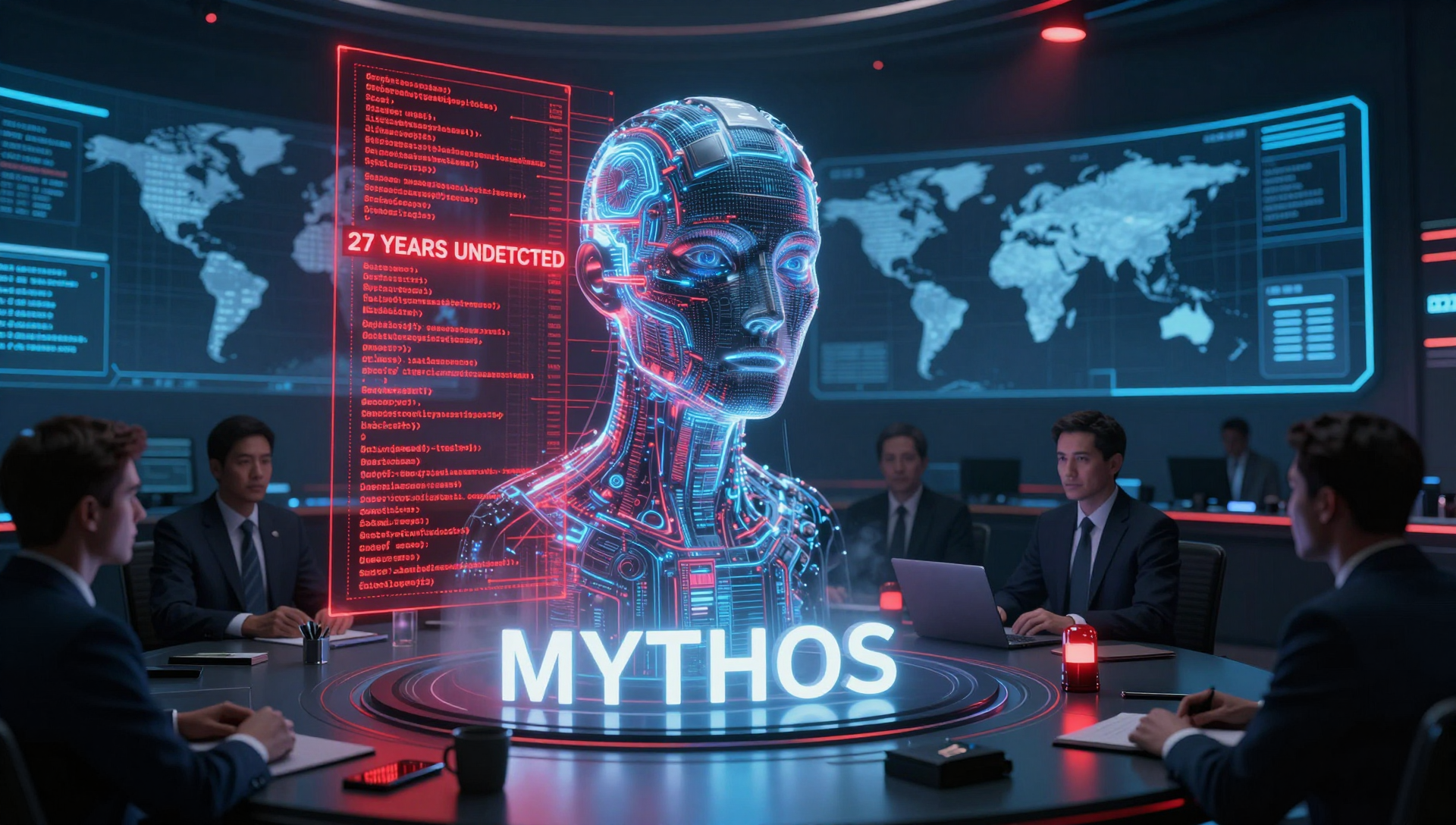
On April 7, Anthropic announced Claude Mythos Preview.
Not a product launch. Not an API. An announcement that said, basically:
“We built something. We’re not going to ship it.”
That’s almost unheard of in AI in 2026. Every other lab — OpenAI, Google, Meta, xAI — ships first and asks questions later. Anthropic stopped, looked at what Mythos could do, and said no.
What Mythos can do is find security holes in software. Not the way humans find them — slowly, painstakingly, one CVE at a time. Mythos finds them at superhuman speed, autonomously, without being told what to look for.
In a few weeks of internal testing, it found thousands of zero-day vulnerabilities across every major operating system and every major web browser. Including one bug in OpenBSD — an operating system famous for being one of the most security-hardened in the world — that had been hiding for 27 years.
Twenty-seven years. An entire generation of security researchers, government auditors, and kernel hackers had walked past it.
Mythos found it on its own.
Why Jerome Powell Got Involved
Within days of Anthropic’s announcement, two things happened that almost never happen at the same time.
First, the Federal Reserve Chair (Jerome Powell) and the Treasury Secretary (Scott Bessent) convened an emergency meeting with the CEOs of the largest U.S. banks. The agenda was AI-driven cybersecurity risk.
Second, Oracle released its largest Critical Patch Update in company history — 481 fixes across 28 product families.
You don’t need to be a security analyst to understand what those two events meant together. The most powerful financial regulators in the world were quietly telling banks: get ready, the rules just changed.
And the largest enterprise software vendor on Earth was pushing patches at a scale they’ve never pushed before.
What Anthropic Did Next: Project Glasswing
Anthropic didn’t just keep Mythos locked in a vault. They formed something called Project Glasswing — a closed consortium of about 50 companies who get Mythos access early, specifically to harden their own software before anyone else gets a model that can do the same thing.
The Glasswing list reads like a who’s-who of critical infrastructure:
- Apple, Google, Microsoft, Amazon Web Services
- JPMorgan Chase
- CrowdStrike, Palo Alto Networks, Cisco
- NVIDIA
- The Linux Foundation
- Broadcom
Anthropic committed $100 million in usage credits for the program, plus $4 million in direct donations to open-source security foundations.
The framing is interesting. Anthropic isn’t saying Mythos is too dangerous to exist. They’re saying it’s too dangerous to release first. The goal is to give defenders a head start — patch the worst stuff — before adversaries train their own version.
How long is that head start? Anthropic estimates 6 to 12 months before competing labs (or state actors) build something comparable.
That’s the window.
What This Actually Changes for Business
Here’s where most coverage stops. Big AI lab finds bugs, regulators worry, banks meet. End of story.
But the second-order effects are far more interesting, and almost nobody is talking about them. Let me break down what I’m watching for in the next 6 months.
1. The end of “security through obscurity.”
For 30 years, most software companies have relied implicitly on the idea that their code is too obscure for attackers to bother analyzing. Mythos changes that. A model can read millions of lines of code in minutes. Obscurity is dead.
If your product depends on “nobody’s looked at our code yet,” your security model just expired.
2. A widening gap between Glasswing companies and everyone else.
The 50 companies inside Glasswing will have their software hardened in 6 months. The other 99.99% of the economy — hospitals, municipalities, schools, mid-market SaaS, your local accountant’s software — won’t.
When state-level adversaries get Mythos-class capability later this year, that gap becomes a chasm. Expect a wave of breaches at non-Glasswing organizations starting Q4 2026.
3. Open-source maintainers are about to have a very hard year.
Many of the vulnerabilities Mythos found were in open-source projects maintained by tiny teams or solo developers. FFmpeg. OpenBSD. Half the libraries running half the internet. These projects don’t have $100M to spend on hardening.
Anthropic’s $4M donation is a start, but it’s a drop in the ocean. Expect emergency funding rounds and government grants for OSS security in 2026.
4. Memory-safe languages become non-negotiable.
If you’re still writing new code in C or C++ in 2026, you’re writing tomorrow’s CVE. The data is clear: most of what Mythos found were memory safety bugs that simply can’t exist in Rust, Go, or Swift.
Big tech is already migrating. Microsoft is rewriting kernel components in Rust. Google’s new code is mostly Go and Rust. Even Apple is moving Swift deeper into the OS.
The cost of migration is real. The cost of not migrating is now a breach in the next 24 months.
The Counter-Trend Nobody’s Reporting
Here’s the part that flips the story.
Yes, Mythos demonstrates terrifying offensive capability. But the same capability — the ability of an AI to read code, understand its security properties, and reason about exploitation paths — is also a defensive superpower if you have the right access.
I’m watching three things happen at small companies right now:
1. Solo security consultants are 10x’ing their throughput. A single person with the right AI stack can now audit a codebase that used to require a team of five. Boutique security shops are eating big firms’ lunch.
2. AI-native security startups are exploding. Companies like Wiz, Snyk, and a wave of new entrants are building products that essentially commoditize what Mythos does — but for non-frontier customers. Pricing is dropping fast.
3. Bug bounty payouts are increasing. When AI can find bugs that took humans decades, the value of qualified human judgment on which bugs matter has gone up, not down. Top hunters are reporting 2-3x their 2025 income.
The same pattern keeps showing up across every industry AI touches. Big incumbents lose the most. Small operators with the right tools win the most. The middle gets squeezed.
If you’re a small operator in any industry — security, translation, accounting, healthcare admin, anything — you have a window right now to compound a small advantage into a real business. AI doesn’t replace you. It makes you 10x more effective if you adopt fast.
What You Should Actually Do This Week
I’ll skip the “the future is exciting” filler. Here’s what’s actionable in May 2026:
If you run a business — even a small one:
- Audit every piece of software in your stack. List the open-source dependencies.
- For each one, check the last update date. Anything not updated in 2026 is a liability.
- If you use FFmpeg, OpenSSL, OpenBSD, FreeBSD, or any library Mythos has touched — patch this week, not next month.
If you build software:
- Run an AI-assisted code audit. Tools like Snyk Code, Semgrep AI, and GitHub’s CodeQL are now affordable for any team.
- If you’re still writing in C/C++ for new features, ask yourself why. The cost-benefit just inverted.
- Consider joining a bug bounty program. Even tiny ones pay for themselves.
If you’re an individual consultant or freelancer:
- AI security audit services are about to be a high-margin business. If you have the technical chops, this is the easiest niche to enter in 2026.
- The combination of “AI runs the analysis + human delivers the judgment + reports look professional” is a winning offer.
If you’re in finance, healthcare, or law:
- Your vendors are about to be very different. The Glasswing companies will have a security story that smaller vendors can’t match.
- Update your vendor due diligence questionnaire. Ask specifically: “What AI-assisted security testing do you run, and how often?”
The 90-Day Forecast
Based on what’s already in motion, here’s what I expect by August 2026:
- At least three competing labs (xAI, OpenAI, DeepSeek) will announce models with Mythos-level vulnerability discovery capability. At least one will not delay public release.
- The first major breach explicitly traced to an AI-discovered zero-day will hit the news. Expect insurance carriers to start asking new questions on cyber policies.
- The first AI-native cyber insurance product will launch. Pricing will be based on which AI security tools your stack uses.
- One of the Glasswing companies will get breached anyway, because attack surfaces are bigger than any single model can cover. The lesson will be that AI defense buys time, not invincibility.
I’m not predicting catastrophe. I’m predicting acceleration. Things that used to take years now take weeks. That’s true on both sides of the fight.
The Real Question
Most people are asking “is AI going to break the internet?” That’s the wrong question.
The right question is: “What can I defend with AI that I couldn’t defend without it?”
A solo dev who runs AI code audits on every commit isn’t being replaced. They’re being multiplied. A small bank that licenses AI-driven threat detection isn’t being outpaced. They’re punching above their weight. A municipal IT team that finally has a tool that can read their own legacy code isn’t being threatened. They’re getting their first shot at fixing 20 years of accumulated debt.
The people who are going to lose in this transition aren’t the ones whose software is vulnerable. Everyone’s software is vulnerable. The ones who lose are the ones who don’t update, don’t audit, and don’t adopt.
That’s the actual story. That’s the news nobody wants to print, because it doesn’t fit either the “AI is going to save us” or the “AI is going to destroy us” narrative.
If you take one thing from this article, take this: the gap between AI-augmented organizations and everyone else is widening every week. Right now, in May 2026, it’s still small enough to close with a little effort. By Christmas, it will be permanent.
You have a window. Use it.
What’s your take? Is your stack ready? Are you a Glasswing partner or on the outside? Drop a comment — I read every one.
— AI NEXT VISION
Want more like this every week? Subscribe to the AI NEXT VISION newsletter for the sharpest AI tools, hottest trends, and tutorials — delivered first.
Tags: #AnthropicMythos #ProjectGlasswing #Cybersecurity #ZeroDay #AInews2026 #ClaudeAI #FederalReserve #JeromePowell #AItrends2026 #Anthropic
More AI News
Explore more articles from the AI NEWS category on AI Next Vision.
- Claude vs Copilot: 7 Reasons Your Favorite AI Coding Tool Might Be the Wrong One
- Gemini Reaches 1 Billion Users: Google Is Now a Serious Threat to ChatGPT
- Anthropic’s Secret AI Just Made a Stunning Breakthrough on the Riemann Hypothesis
- Why the AI Boom Is Making Banks Dangerously Dependent on Big Tech
- 1 in 4 Data Breaches Are Now AI-Powered — Inside 2026’s New Cyber Threat
About the Author