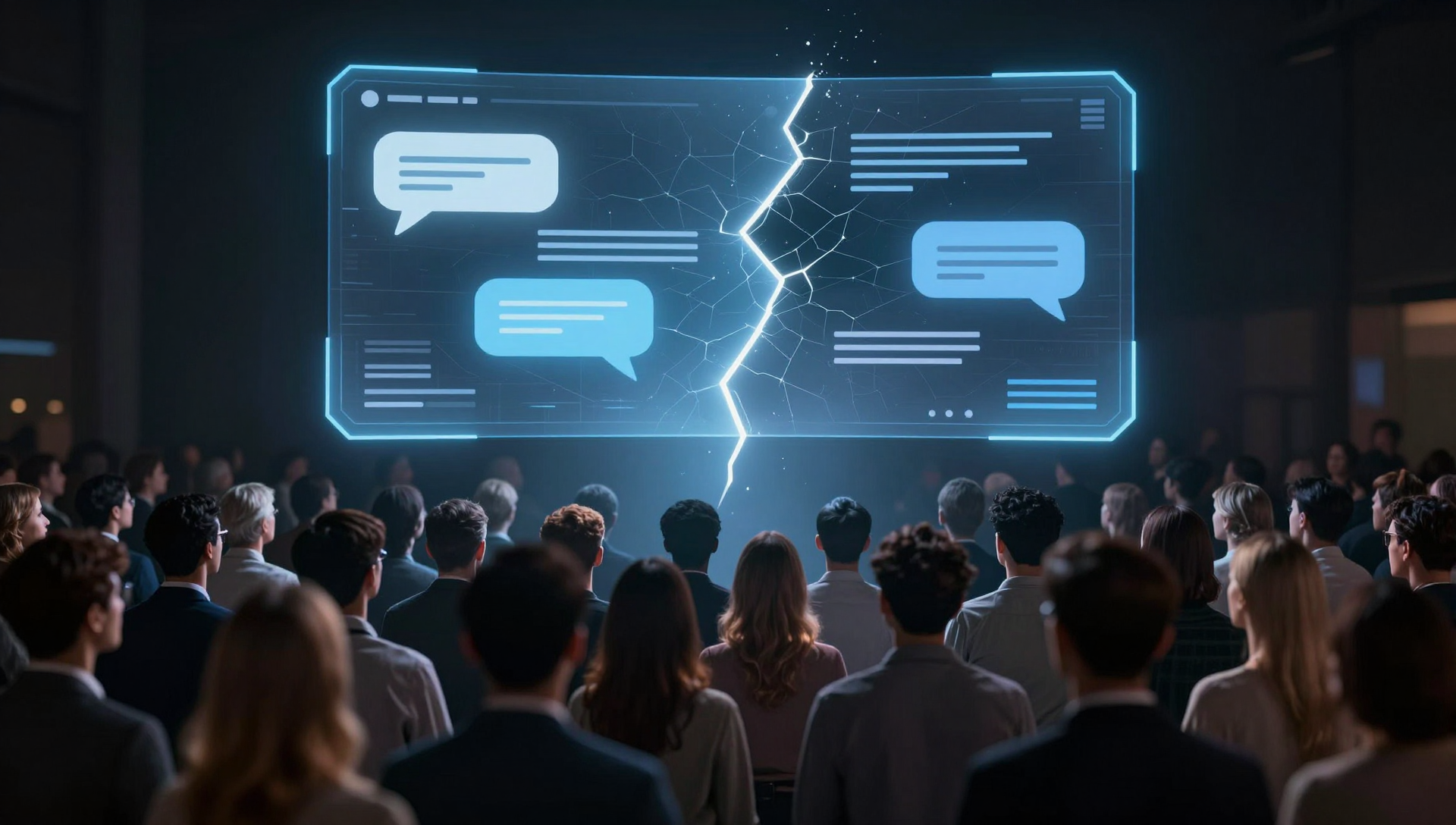
ChatGPT 1 billion users
- ChatGPT crossed 1 billion monthly active users in May 2026 — the fastest any application in history has reached that milestone, roughly three years after its November 2022 launch.
- Generative AI hit 53% global population adoption within three years, faster than either the personal computer or the internet reached comparable levels (Stanford AI Index 2026).
- Yet the trust gap is widening: only 10% of Americans say they’re more excited than concerned about AI, compared to 56% of AI experts.
- On jobs, 73% of experts expect a positive impact — only 23% of the public agrees (Stanford AI Index 2026).
- Just 31% of Americans trust their government to regulate AI, the lowest figure of any surveyed country and well below the global average of 54%.
- 47 countries now have AI legislation, but only 12 have real enforcement mechanisms — adoption is racing ahead of the rules meant to govern it.
Something strange is happening in AI right now, and the two halves of the story don’t fit together.
In May 2026, ChatGPT became the first application in history to reach one billion monthly active users. No app has ever climbed that mountain faster — not Facebook, not Instagram, not TikTok. Three years from launch to a billion people. That’s the kind of number that usually comes with a celebration.
But here’s the part that should give everyone pause. In the same window that usage exploded, public trust in AI fell to its lowest recorded level. According to Stanford’s 2026 AI Index — the most comprehensive annual snapshot of the field — only one in ten Americans now feels more excited than worried about where this is going.
Record adoption. Record distrust. At the same time. That’s not a contradiction in the data. That is the data. And it tells you more about 2026 than any benchmark score could.
The Milestone That Arrived Faster Than Anyone Predicted
Let’s start with the scale, because it’s genuinely hard to wrap your head around.
A billion monthly users means roughly one in eight people on the planet now opens ChatGPT in a given month. The Stanford report frames the broader picture clearly: generative AI reached 53% adoption across the global population within three years of ChatGPT’s debut. The PC took longer. The internet took longer. Nothing has moved through society this fast.
And it’s not just casual use. By the end of 2025, 58% of employees worldwide reported using AI at work on a regular or semi-regular basis. In countries like India, China, Nigeria, Egypt, the UAE, and Saudi Arabia, that figure climbed past 80%. For a deeper look at how this shift is already reshaping daily work, our breakdown of how people are actually making money with AI agents in 2026 covers the ground-level reality.
So on paper, this is the most successful technology rollout of the modern era. Which makes the second half of the story so jarring.
The Number Stanford Almost Buried
If you only read the headlines about the 2026 AI Index, you’d think it was a victory lap. Models now beat human baselines on PhD-level science questions. Coding performance on the SWE-bench Verified benchmark jumped from 60% to nearly 100% in a single year. The capability charts all point up and to the right.
Then you reach the public opinion chapter, and the mood changes completely.
The gap between the people building AI and the people living with it has become a chasm. Look at how differently the two groups answer the same questions:
- On the economy and jobs: 73% of experts expect AI to help. Only 23% of the public agrees.
- On healthcare: 84% of experts think AI will improve medical care. Only 44% of the public does.
- On overall sentiment: 56% of experts are more excited than concerned. Among ordinary Americans, that drops to 10%.
These aren’t small differences in tone. They’re two populations looking at the same technology and reaching nearly opposite conclusions about whether it’s good for them. The experts see a tool. A large share of the public sees a threat to their livelihood that arrived without their consent.
And that anxiety isn’t irrational. It’s downstream of real events — like the wave of job cuts we covered in the AI layoff wave that hit America in May 2026, and the headlines about models like GPT-5.4 outperforming humans on workplace tasks. When the same week brings news that a model can do your job and that your company is hiring fewer people, “more concerned than excited” stops looking like fear of the unknown and starts looking like a reasonable read of the situation.
Why the Gap Keeps Widening
The instinct in Silicon Valley is to call this an education problem. If people just understood the technology, the thinking goes, they’d trust it. The data suggests that’s exactly backward.
Trust isn’t falling because people don’t understand AI. It’s falling because they understand it well enough to have specific, grounded worries — about jobs, about who’s in control, and about whether anyone is actually steering this.
Three forces are pulling the gap apart:
Jobs feel personal in a way benchmarks never will. An expert reads a capability jump as progress. A worker reads it as a countdown. Only about a third of Americans expect AI to make their own jobs better, and that number shapes everything else.
The wins are abstract; the costs are concrete. “AI passed a medical exam” is a press release. A layoff notice is a Tuesday. When the benefits live in headlines and the disruption lands in your inbox, distrust is the rational default.
Nobody feels like they have a say. This is the quiet driver underneath all of it, and it leads straight to the most damning number in the whole report.
The Regulation Vacuum
Here’s the statistic that should worry policymakers more than any other.
Only 31% of Americans trust their own government to regulate AI effectively. That’s the lowest figure of any country Stanford surveyed, and it sits far below the global average of 54%. In other words, the country producing the most advanced AI in the world has the least faith that anyone is minding the store.
The structural picture backs up that pessimism. Forty-seven countries now have some form of AI legislation on the books — but only 12 have actual enforcement mechanisms behind it. Laws without teeth are just suggestions, and the public can tell the difference. The EU AI Act entered full enforcement in January 2026, and globally the EU is trusted more than either the US or China to regulate AI well. But the overall regulatory landscape looks less like a coordinated framework and more like a patchwork that varies wildly from one border to the next.
So you end up with a system where the technology is moving at the speed of a billion-user rollout, and the rules are moving at the speed of legislation. That gap — between how fast AI is being adopted and how slowly it’s being governed — is exactly where public trust goes to die.
What This Actually Means If You Build or Use AI
If you create content, run a business, or build with these tools, the trust gap isn’t an abstract policy debate. It’s a practical reality you’re already operating inside. A few things follow from it:
Transparency is becoming a competitive advantage. As distrust rises, the creators and companies who are open about how and where they use AI will earn something their competitors can’t fake. If you publish AI-assisted work, say so, and show the human judgment behind it.
The “expert vs public” gap is a content opportunity. Most coverage is written by the optimistic 56%, for the optimistic 56%. There’s an enormous, underserved audience that’s curious about AI but deeply skeptical — and very little content speaks to them honestly. Meeting that skepticism head-on, rather than dismissing it, is how you build a real audience. Our AI Trends and AI News sections are built around exactly that kind of grounded coverage.
Usefulness beats hype. A billion people didn’t adopt ChatGPT because of a benchmark. They adopted it because it saved them time on a real task. If you want to bring skeptics along, lead with what the tool concretely does for them — the same practical angle we take in the guide to using ChatGPT for business growth in 2026.
Where This Goes Next
The optimistic read is that trust is a lagging indicator. Every transformative technology — electricity, cars, the internet — went through a period where adoption outran public comfort, and the gap eventually closed as the rules caught up and the worst fears didn’t materialize.
The pessimistic read is that this time is structurally different. The speed is unprecedented, the economic stakes hit ordinary workers directly, and the governance is fragmented across nearly fifty different rulebooks. If trust keeps falling while usage keeps climbing, you get a society that depends on a technology it has actively stopped believing in. That’s not a stable place to stay.
What’s almost certain is that the next chapter of AI won’t be decided by capability alone. The models will keep getting better — that part is no longer in question. The open question is whether the people using them, governing them, and being affected by them can be brought back into a story they currently feel happened to them rather than with them.
A billion users say the tool works. Ninety percent of Americans say they’re worried anyway. Closing the distance between those two facts is the real frontier of 2026 — and no benchmark is going to do it for us.
Frequently Asked Questions
How many people use ChatGPT in 2026? ChatGPT crossed 1 billion monthly active users in May 2026, making it the fastest application in history to reach that milestone — roughly three years after its November 2022 launch.
What does the Stanford AI Index 2026 say about public trust? It documents a sharp split between experts and the public. Only 10% of Americans say they’re more excited than concerned about AI, versus 56% of experts. On jobs, 73% of experts expect a positive impact compared to just 23% of the public.
Why is trust in AI falling if usage is rising? The two trends aren’t contradictory. People are adopting AI because it’s useful, while simultaneously worrying about job loss, weak regulation, and a lack of control. Only 31% of Americans trust their government to regulate AI effectively — the lowest of any country surveyed.
Is AI being regulated effectively? Partially. 47 countries now have AI legislation, but only 12 have real enforcement mechanisms. The EU AI Act entered full enforcement in January 2026, and globally the EU is trusted more than the US or China to regulate AI well.
Sources
- Stanford Institute for Human-Centered AI (HAI) — 2026 AI Index Report, Public Opinion chapter
- Industry reporting on ChatGPT’s 1 billion monthly active user milestone, June 2026
- Stanford AI Index 2026 data on global generative AI adoption and workplace usage
Want more grounded AI analysis without the hype? Explore our AI News and AI Trends sections, or see what’s changing at the top in ChatGPT Trends 2026: The AI Giant Facing a New Reality.
More AI News
Explore more articles from the AI NEWS category on AI Next Vision.
- Why the AI Boom Is Making Banks Dangerously Dependent on Big Tech
- 1 in 4 Data Breaches Are Now AI-Powered — Inside 2026’s New Cyber Threat
- AI Agents Are Now Fact-Checking Science — And Catching Decades-Old Errors
- AI Agents Are Getting Their Own Wallets — Inside the Rise of Agentic Payments
- Google Shakes Up Its AI Leadership — Demis Hassabis Steps Back as DeepMind CEO
About the Author
