When people compare AI video generators, the conversation usually starts with the same question: Which one looks better?
That makes sense. A few seconds of impressive AI-generated video can be enough to make a tool go viral.
But if you’re actually using AI video for work, visual quality is only part of the story.
A clip can look amazing and still be frustrating to use. Maybe the camera moves in the wrong direction. Maybe the character’s face changes halfway through the shot. Or perhaps you need to make one small change and end up generating the entire clip again.
That’s where the comparison between Hailuo vs Runway becomes more interesting.
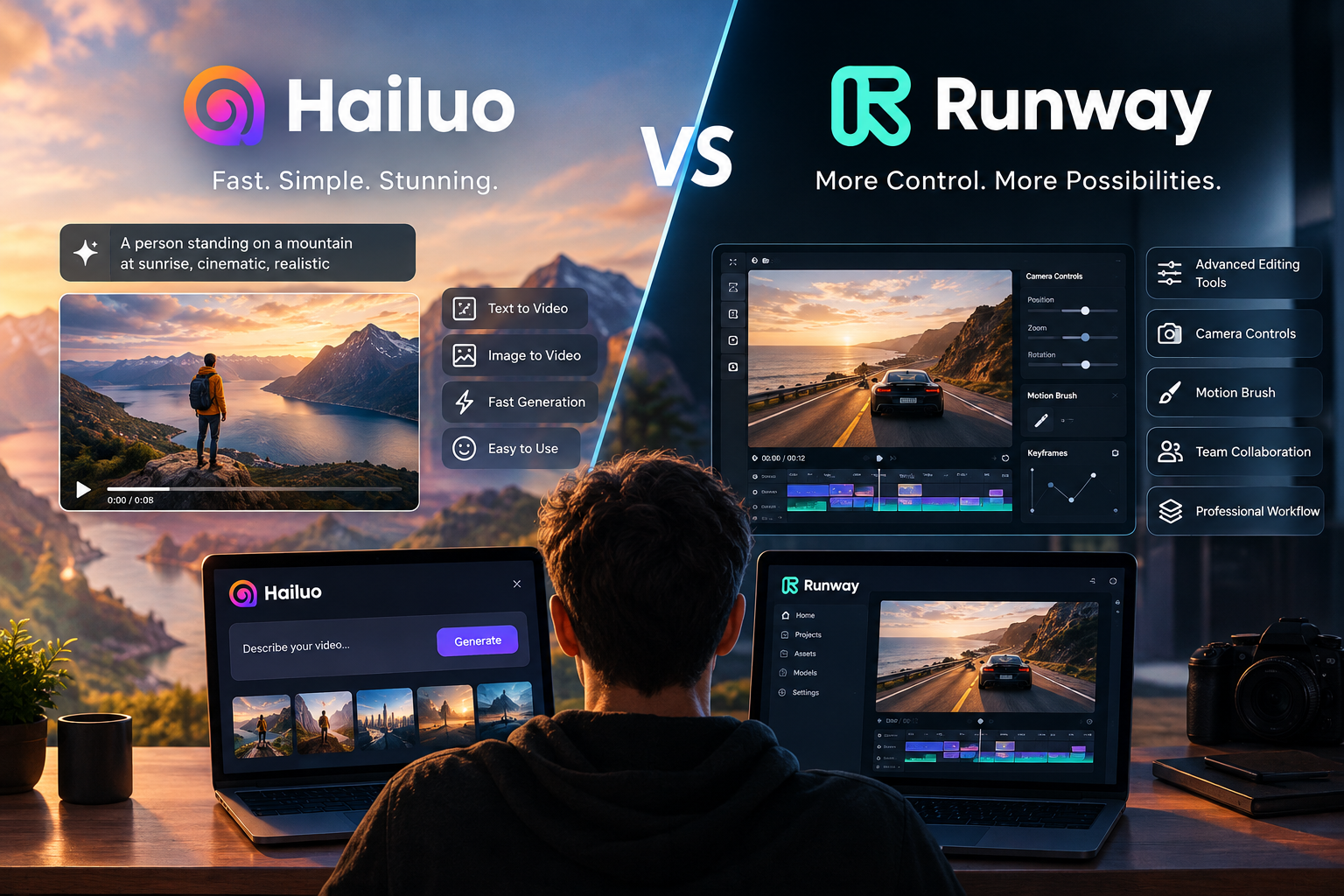
Both platforms can produce impressive video, but they approach the creative process differently. Hailuo is particularly attractive when you want to experiment quickly and get natural-looking motion from a simple prompt. Runway, on the other hand, puts more emphasis on creative control and tools that fit into a professional production workflow.
So which one should you use?
The answer depends less on benchmark scores and more on what you’re actually trying to create.
Key Takeaways
- Hailuo is great for fast experimentation and visually impressive short clips.
- Runway offers more creative control, which can become important when you’re working on a larger project.
- Neither platform completely solves the problem of character and scene consistency.
- The cheapest generator isn’t necessarily the cheapest option once you factor in failed generations and editing time.
- For casual creators, Hailuo can be an easy place to start. For structured production work, Runway may make more sense.
Hailuo vs Runway: What’s the Real Difference?
At a basic level, both Hailuo and Runway let you turn ideas into short videos using text prompts, images, or a combination of both.
The difference becomes clearer once you start using them repeatedly.
Hailuo tends to feel like a generation-first tool. You describe what you want, experiment with different prompts, and see what the model comes up with.
That’s useful when you’re creating social media content, testing an idea, or looking for inspiration.
Runway takes a more production-oriented approach. Alongside generation, it provides tools designed to give creators more control over the result.
That distinction matters.
Imagine you’re creating a short advertisement for a client. If you’re simply looking for five different visual concepts, Hailuo can be very useful. But if the client says, “Keep everything the same, but change this specific part of the shot,” having more editing and control options becomes much more valuable.
In other words, generating a good video and directing a video aren’t exactly the same thing.
Why Benchmark Results Don’t Tell the Whole Story
AI video benchmarks are useful, but they don’t tell you what happens after the first generation.
A benchmark might show that one model follows a prompt particularly well. That’s interesting, but real production rarely ends with the first successful generation.
You usually have to make changes.
Maybe the lighting is wrong. Maybe the character is looking in the wrong direction. Maybe the camera movement doesn’t fit the rest of the sequence.
This is where workflow starts to matter more than a benchmark score.
1. Control Over the Result
The biggest question is simple:
How much control do you need?
If your goal is to generate interesting clips quickly, Hailuo’s straightforward approach can be an advantage.
If you’re building a more structured sequence and need to manipulate individual elements, Runway’s broader set of creative tools can give you more flexibility.
The difference becomes particularly noticeable when you’re working with client feedback.
Generating another clip isn’t difficult.
Generating the same clip with one specific change is much harder.
2. Character Consistency
Consistency remains one of the biggest challenges in AI video generation.
A character may look perfect in the first shot and slightly different in the next. Facial features can shift, clothing can change, and small details may disappear as the scene develops.
Image-to-video workflows can help because the initial image gives the model a stronger visual reference.
Runway is particularly interesting for creators who want to build more controlled image-to-video workflows, while Hailuo can be very effective when the priority is simply producing a convincing result from an idea.
Neither platform completely eliminates consistency problems, though.
That’s still one of the areas where AI video has plenty of room to improve.
3. Editing and Production Workflow
This is probably the biggest difference between a tool you enjoy experimenting with and one you can use every day for client work.
A generated clip rarely goes straight onto a finished project.
You may need to trim it, change the framing, add sound, combine it with other footage, correct colors, or generate several variations before you have something usable.
Runway has positioned itself strongly around this broader creative workflow.
Hailuo can be excellent at producing the initial visual, but you may find yourself relying more heavily on other software once the generation stage is finished.
For a creator who only publishes short clips, that may not matter.
For an agency producing videos every week, it can make a significant difference.
What About Cost?
Price is another area where the comparison isn’t as straightforward as it first appears.
A cheaper generation doesn’t necessarily mean a cheaper production.
Suppose one tool gives you a great-looking result quickly, while another gives you more control but takes longer to learn.
Which one is cheaper?
It depends on how you work.
For beginners and creators experimenting with AI video, a generous free or low-cost option can be extremely useful. It lets you test ideas without committing to a large subscription.
For professional teams, however, time is also a cost.
If you spend an hour trying to reproduce a shot that could have been controlled more easily in another platform, the difference in subscription price becomes much less important.
That’s why it’s better to compare total workflow cost, rather than simply looking at the monthly price.
Real-World Use Cases
The best choice also changes depending on the type of content you’re producing.
Social Media Creators
If you’re creating TikTok, Instagram Reels, Shorts, or experimental YouTube content, Hailuo can be a very attractive option.
You can quickly test unusual ideas and generate visually interesting clips without building a complicated production process around them.
For this type of work, speed and experimentation are often more important than frame-level control.
Marketing Teams
Marketing teams have slightly different requirements.
They may need ten versions of the same advertisement, different backgrounds, product variations, or several concepts for testing.
Both tools can be useful here, but the more specific the requirements become, the more important creative control becomes.
For example, if you need the same product to appear consistently across multiple shots, you’ll want to pay close attention to how each platform handles reference images and consistency.
Professional Video Editors
Editors and production teams usually care about what happens after generation.
They need predictable exports, repeatable results, and tools that don’t force them to start over every time something changes.
That’s where Runway’s production-oriented approach can become more appealing.
Hailuo can still be useful as a rapid ideation tool, particularly when the editor wants to generate several visual concepts before deciding which direction to pursue.
A Simple Test You Can Run Yourself
Instead of relying entirely on reviews, there’s an easy way to compare Hailuo vs Runway for your own workflow.
Step 1: Use the Same Prompt
Take one detailed prompt and run it through both platforms.
Don’t change the wording.
Look at:
- Motion quality
- Prompt adherence
- Lighting
- Camera movement
- Detail
- Overall realism
Step 2: Try Image-to-Video
Use the same reference image in both tools.
Pay particular attention to the face, clothing, background, and small visual details.
This will tell you much more about consistency than simply comparing two random text-to-video generations.
Step 3: Try to Fix One Problem
This is the most important test.
Take the better result and identify one thing you don’t like.
For example:
“Keep everything the same, but make the camera move more slowly.”
Now see how easily you can achieve that.
This is where the difference between generation quality and production control becomes obvious.
Step 4: Calculate the Real Cost
Don’t only compare credits.
Track how many generations you needed before getting a usable result.
If one platform requires three attempts and another requires eight, the difference can become significant over dozens or hundreds of clips.
Hailuo vs Runway Comparison
| Feature | Hailuo | Runway |
|---|---|---|
| Quick experimentation | Excellent | Very good |
| Natural-looking motion | Strong | Strong |
| Creative control | More limited | More extensive |
| Professional workflows | Growing | Strong |
| Beginner friendly | Yes | Yes, but more to learn |
| Rapid concept generation | Excellent | Very good |
| Complex production | Better with external tools | Better suited |
| Best for | Creators and experimentation | Editors, agencies and production |
Which One Should You Choose?
There isn’t a universal winner.
Choose Hailuo if:
- You want to experiment quickly.
- You’re mainly creating short-form content.
- You care about getting attractive results without a complicated workflow.
- You’re still learning what AI video can do.
Choose Runway if:
- You’re working on client projects.
- You need more control over your footage.
- You’re building multi-shot or more structured content.
- You want generation and creative tools closer together.
And there’s nothing stopping you from using both.
In fact, that may be the most practical approach.
Use Hailuo when you need to explore an idea quickly. Use Runway when you need more control over an idea that has already made it into production.
The Bigger Business Question
For businesses, the important question isn’t:
“Which AI video model won the benchmark?”
It’s:
“Which tool helps my team produce the final video faster?”
That’s a much more useful question.
A marketing department doesn’t get paid for generating impressive demos. It gets paid for producing campaigns.
An agency doesn’t need an AI model that looks great in a comparison video. It needs one that can survive revisions from clients.
And a YouTube creator doesn’t necessarily need the most advanced production suite. They may simply want to turn an idea into a good-looking clip in a few minutes.
The right tool depends on the job.
Final Verdict
If your priority is fast experimentation and creative exploration, Hailuo is an excellent option to consider.
If your priority is control, editing and a more structured production workflow, Runway is likely the stronger choice.
But don’t make the decision based on one viral generation or one benchmark.
Run the same prompts.
Use the same reference images.
Try to fix the same mistakes.
Then calculate how much time and how many credits you actually spend getting a finished result.
That’s a much better test of Hailuo vs Runway than asking which one produces the prettiest five-second clip.
Quick Verdict
- 🏆 Best for rapid experimentation: Hailuo
- 🎬 Best for production control: Runway
- 💡 Best approach for serious creators: Test both and use each where it performs best
- 💰 Best value: Depends on how many usable generations you get per project
More AI Comparisons
Explore more articles from the AI Comparisons category on AI Next Vision.
- I Tested Chatbase and Botpress — The Results Shocked Me
- I Compared ChatGPT and Llama — The Results Surprised Most Developers
- Stop Overthinking AI Coding — Here’s What Actually Matters in 2026
- ChatGPT vs Gemini for Writing: Which AI Tool Actually Delivers in 2026
- ChatGPT vs LLaMA in 2026: Which AI Model Is Better for Business Tasks?
About the Author